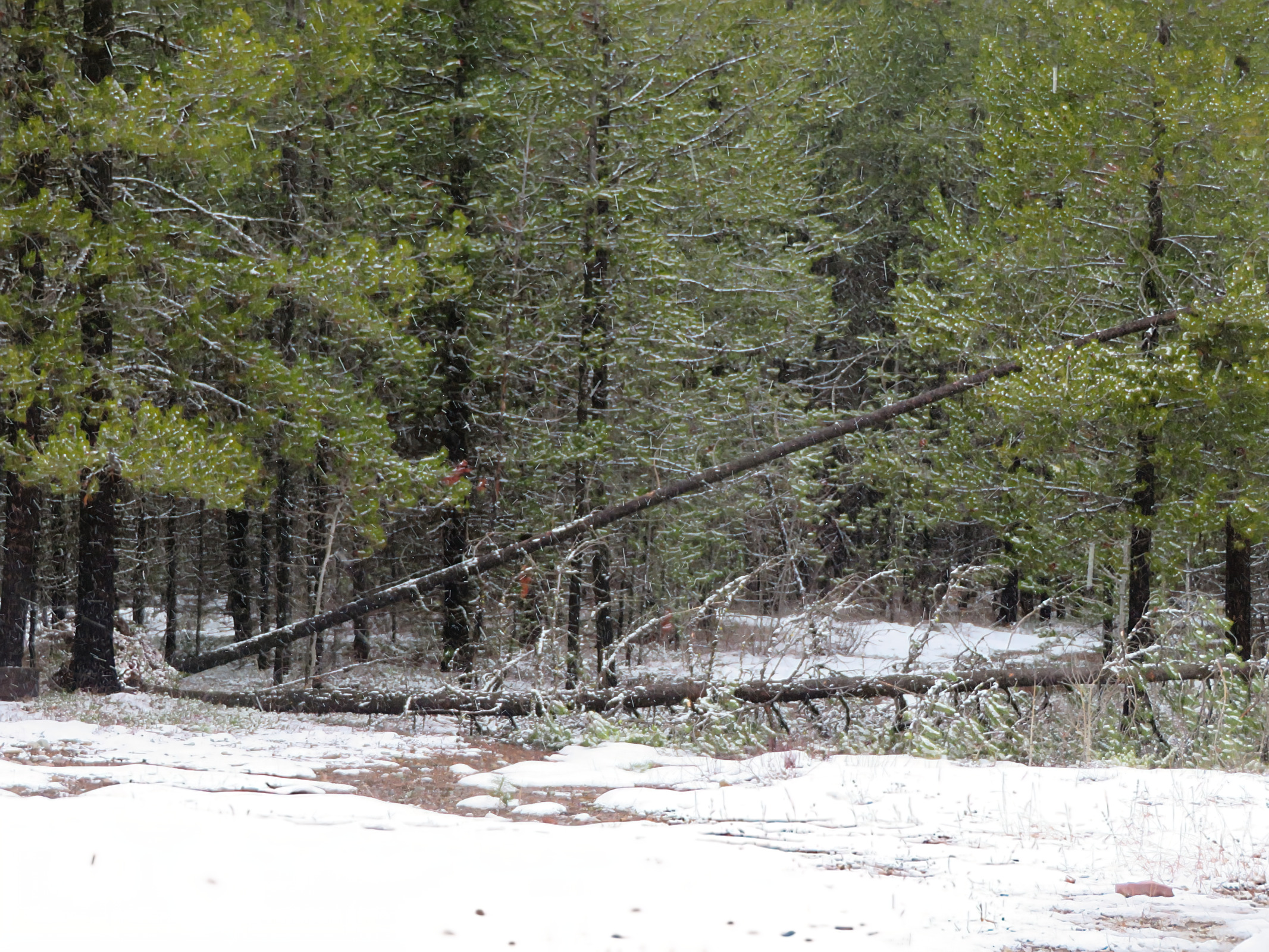
 The area’s December 2025 windstorm caused a lot of damage. All that downed wood will attract beetle activity as soon as things warm up a bit. Although she wasn’t able to attend the meeting, Holly McKenzie, the local Service Forester for the Montana Department of Resources and Conservation (DNRC), put together a set of cleanup recommendations, along with supporting materials, which were made available at the Interlocal meeting on February 11.
NOTE! We hope to get Holly to make a presentation to the community at Sondreson Hall in late spring.
Here is the full text of the cleanup recommendations, followed by links to all the handouts . . .
December Windstorm Event and Tree Cleanup Recommendations
The 50-75 mile per hour winds in December caused extensive damage to forestland across much of Western Montana. The areas most impacted by the storm were canyons that funneled winds out of the west or higher ridges without protection. The lack of cold temperatures and heavy rainfall left the root systems quite vulnerable to wind throw, especially where recent harvesting or thinning took place within the past 2-3 years. Where trees were thinned 5-10 years ago, the roots grew more root fibers and had strength to withstand gale force winds.
There are large pockets of blowdown near the Thompson Chain of Lakes, Island Lake, Eureka, Trego, the Bitterroot, Star Meadows and Reid Divide, Farm to Market Road, Olney and Good Creek, Tally Lake, Rogers Lake, West Glacier, Blankenship, and of course, the North Fork of the Flathead River drainage.
There is some urgency to do cleanup work so that pine won’t end up degraded by delaying salvage operations until after the warm weather moves in around May. Once the weather warms, beetle activity will commence (different timing for each species of beetle) and downed timber would begin to dry and crack. Blue stain is likely to show up in the pine within 3-6 weeks and the staining devalues the wood significantly when it gets scaled and graded at a sawmill.
Douglas-fir blowdown may have more time before it dries and salvaging is not as critical in the first month of Summer. They may, however, attract bark beetle or the larger wood borers which flock to stressed trees or downed logs.
In addition, even if someone doesn’t plan to sell sawlogs or only have post and rail size trees, the result of a lot of blowdown may attract bark beetle outbreaks the year following because all the stress signals sent out by downed slash and leaning trees, will draw in IPS (pine engraver) or Western Pine beetles to the lodgepole, as well as Douglas-fir bark beetle into the larger Doug-fir trees.
We don’t have any grant funding to take care of this unfortunate event, nor do we see any funding coming down the pike early this year unless you live in the Wedge Canyon Fire Footprint and you have applied for NRCS funds already. For the majority of landowners, it will make sense to salvage trees on their own or find good contractors to help salvage those trees and move them to a mill or firewood yard. Leaving them stacked for later, or leaving them beyond late Fall, is a recipe for beetle outbreaks in 2027! The beetles that move in this year would lay eggs, commence to hatch and pupate under the bark, and emerge as adults the following May and June of 2027 where new trees would be hit.
There are some excellent lists of thinning and logging contractors available through the DNRC, the NRCS, MWED, or contact a local sawmill. The DNRC offers landowner visits to help answer your forest health questions and direct you toward the best resources to use if management is recommended.
I’ve attached some information about the life cycle of pine bark beetles and Douglas-fir bark beetles. There are even some small pockets of spruce bark beetle in the North Fork of the Flathead which warrants monitoring and management if you have it.
The State Entomologist, Amy Gannon, put together the quick help sheet for finding MCH pheromone caps below. The MCH is fairly effective in deterring Douglas-fir bark beetle during April and May flights.
There is not an effective deterrent for pine bark beetle unless you have Mountain Pine Beetle which we don’t have active populations of currently. Don’t waste your money on Verbenone anti-aggregate pheromones for pine until we get another outbreak of Mountain Pine Beetle. Verbenone does not work on Western Pine Beetle or Ips (pine engraver) beetle.
Pine beetle activity is most quickly eliminated by burning slash and cleaning up downed trees as soon as possible. They need to be cut into firewood and stored in a dry place or sent to the mill where the bark will be removed. The larvae and sub-adults need moist cambium to feed and survive. When the cambium layer is removed or dried out, the eggs and larvae fail to finish their life cycle.
In large slash piles, they tend to move deeper into the center of the slash rather than flying on to other trees, however, small slash piles harbor the Ips beetles and need to be burned as quickly as possible. Hand piles are susceptible to beetle activity in pine stands. The slash is not so much an issue with Doug-fir, larch, spruce, or cedar stands. As always, the best deterrent for beetles, is a thinned and healthy forest where the trees are able to get the resources they require (water, nutrients, and sunlight).
________________________
Many of you are likely getting questions about MCH to repel Douglas-fir beetle (DFB). Here are a few quick highlights and points to remember:
-
- MCH (bubble caps/pheromone packets) Only repels Douglas-fir beetle. DFB is pretty active throughout host range so I’m generally recommending that landowners protect susceptible trees, if within their budget.
- Must be hung by April 15th to be effective when beetles typically fly mid-May
- Packets only last for one season.
- Double bubble from Synergy (1000mg) can be hung on grid of 15/acre. Single tree protection still requires 2-3/ tree, depending on diameter. Hang on NW/NE if possible.
- Single bubble (400-500mg) grid application 33/acre. Single tree application also 2-3/tree, depending on diameter.
- MCH has an EPA registration # and is therefore treated as a pesticide. Please be sure to wear proper protective gear when hanging.
I’m trying to compile a list of distributors. Here’s who I know of thus far:
-
- Synergy Semiochemical: https://semiochemical.com/mch/ 604-454-1122
- Dillon Distributors: Using MCH Releasers to Proctect Trees from Douglas-fir Beetle (dillondistributors.com) 406-239-5485
- Swan Valley Connections (group purchase); https://swanvalleyconnections.formstack.com/forms/bubble_caps_order_form
- Forestry Distributing: MCH Repellents – Try Bubble Caps Or Flakes | Forestry Distributing | Forestry Distributing North America’s Forest Products Leader 303-747-6414
Trap trees can be used to help control beetle outbreaks. This method involves felling a large Douglas-fir and leaving it on the ground through summer to attract beetles. Before fall, the tree should be processed—such as bucked for firewood, split, debarked, or sent to a mill—to destroy beetle broods and egg galleries before they develop into larvae and adults.
Document links . . .
Blowdown Recommendations for North Fork Interlocal Meeting
Douglas-Fir Beetle – Forest Health Fact Sheet
IPS Beetle outbreaks
Spruce Bark Beetle Management Options
Western Pine Beetle Life Cycle