September Wildland Fire Outlook

Here is the link to the September/October/November Wildland Fire Outlook: https://www.nifc.gov/nicc/predictive/outlooks/monthly_seasonal_outlook.pdf

For September in the Northern Rockies: Above Normal significant large fire potential is expected in all areas except Yellowstone National Park and eastern North Dakota in September where Normal Potential is expected.

In October Above Normal significant large fire potential will continue across the southern Idaho Panhandle and across most of Montana, except the Kootenai Region and Southwest Montana. Western North Dakota will also experience elevated potential in October as well.

This is grim news. While we will see diminished potential for lightning starts as the season progresses, the relief we need in terms of a season-ending moisture event looks elusive. And with the number of new starts across the state during the past few days, there is a lot of fire on the landscape that will not go out on its own. In addition we don’t have enough overhead teams/crews/engines/aircraft to staff the fires that are active now.

This is going to be a very tough September and October for Montana. I’m hoping that escaped hunter fires don’t add significantly to the fire situation….

Let’s be careful out there.
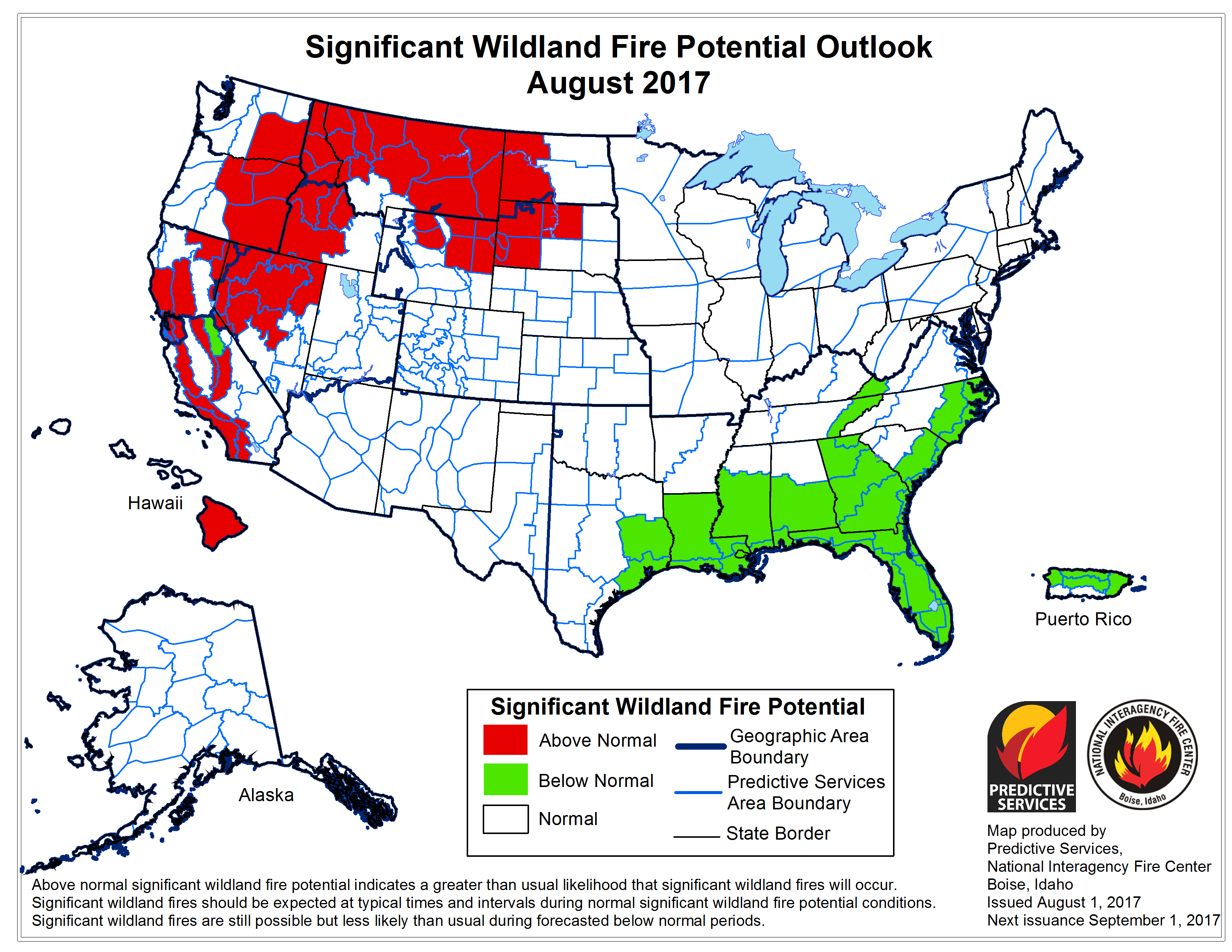
Outlook for Wildland Fire for August/September/October

Significant Wildland Fire Potential Outlook for August 2017

Here is the Outlook for Wildland Fire for August/September/October:  https://www.nifc.gov/nicc/predictive/outlooks/monthly_seasonal_outlook.pdf

This Outlook better represents the conditions we are seeing, both up the North Fork as well in more severe burning conditions across the rest of Montana.  This is in sharp contrast to the forecast from Predictive Services we received at our IMT Spring Meetings which forecasted a “slow normal” fire season for the Northern Rockies.  I think we have exceeded the acres burned by August 1 that they forecasted for the entire season – and you all know that we have six to eight weeks of fire season left.

I just returned yesterday from a 12 day assignment as Deputy Plans Chief with Shawn Pearson’s North Idaho Type 2 Team on the Sunrise Fire outside of Superior, Montana.  Doug Turman’s Type 1 Team replaced us, because it is truly a Type 1 Fire.  Pearson’s Team had been assigned several days before I was ordered – I was one of the folks they ordered to expand the Team’s capability to manage a complex incident.

The fuels in Southwest Montana are extremely dry.  Operations did an incredible job burning out heavy fuels around structures that had been evacuated.  As I left yesterday, the Team had not lost a structure, which was incredible as well.  Our fuels in the mid and higher elevations in the Flathead are retaining more live fuel moisture, but that may not last long if the heat does not moderate.  This is very similar to the 2007 fire season where the Flathead saw large fires – Brush Creek west of Whitefish in Star Meadows, and Skyland Creek Fire in the Skyland Creek area that burned over Marias Pass through the Lewis and Clark National Forest, and onto the Blackfeet Reservation.  The North Fork dodged the bullet in 2007.  I hope we are as fortunate again.

Anyway, I’m thinking I may not have much time up the North Fork until after the season ends.  And I wouldn’t expect that until October 1 at the earliest.  We all know they can extend with nice fall weather as well.

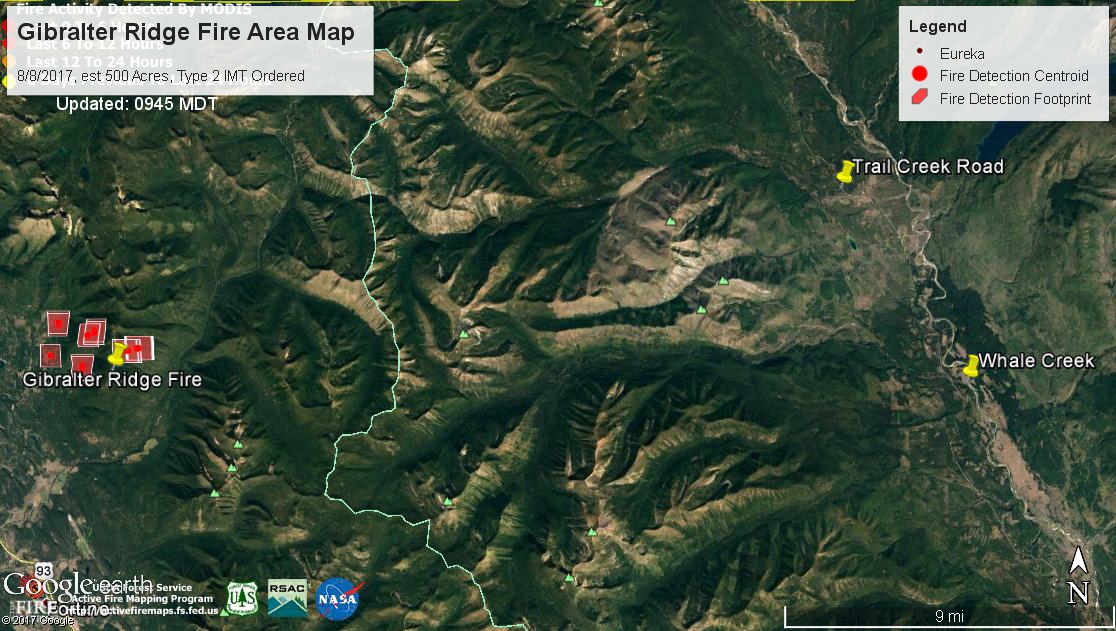
Closure of Trail Creek Road

This is a new closure order from Rob Davies, District Ranger of the Forest Service, via Allen Chrisman on the Kootenai, as a result of the Gibraltar Ridge Fire in the Eureka area.

This closure effects travel from the North Fork over Trail Creek onto the Kootenai.  We will be posting signs today at the North Fork (junction of North Fork Road and Trail Creek Road), and at Tuchuck Trail Head.

This also affects the Pacific Northwest Trail.  We will post the order at strategic trailheads for the PNW in coordination with the Kootenai.

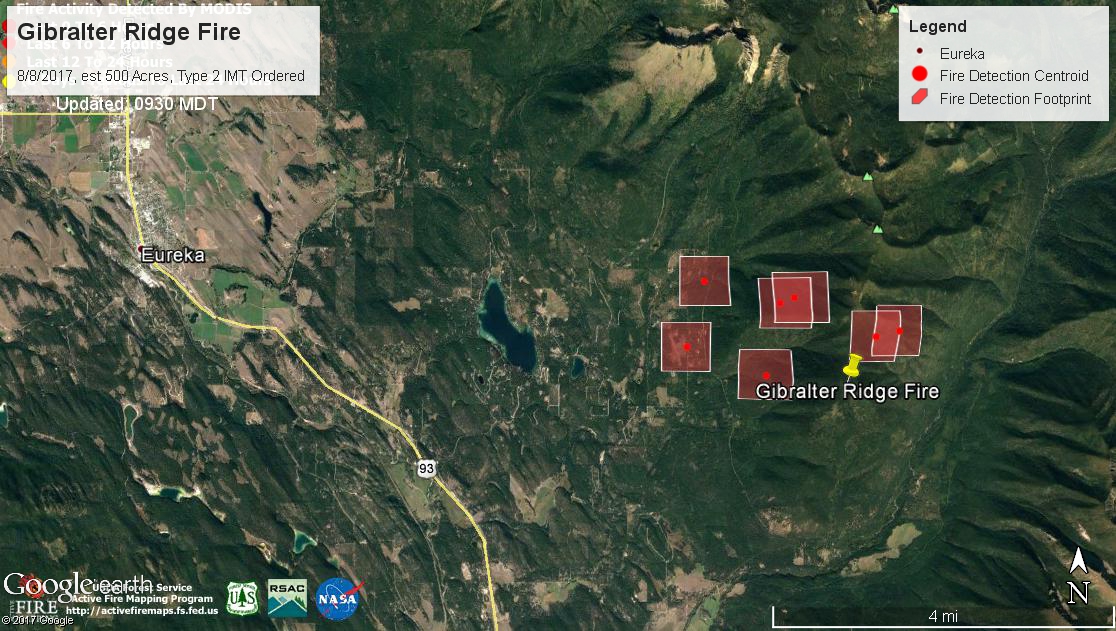
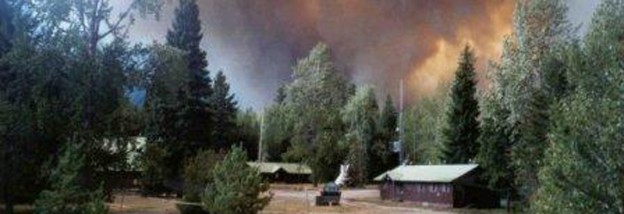
Gibralter Fire in Lower Graves Creek East of Eureka

I see that according to Kootenai Dispatch WildCAD, there is a new large fire (estimated 500 acres) 7 miles east of Eureka in lower Graves Creek.  It is about 20 miles due west of the North Fork Road at Whale Creek.  A Type 2 Incident Management Team has been ordered.  Rick Connell’s Western Montana IMT has been reserved, which means they will be assigned as soon as the inbriefing is set up.

I can’t forecast the fire movement from what I know, but it would appear to be unlikely that it will progress northeast up Graves Creek and come down Trail Creek.  I think it is more likely it will make runs to the east following lateral drainages.  If it came over the top, it would run into the Wedge Canyon fire scar above Hornet.  And I’m not sure how those regenerated stands would affect fire behavior.  It would be easier for an overhead team to construct fuel breaks and fire out compared to heavy timber fuels.

I attached the current Google Earth images showing the approximate fire location.

My take is that this is a serious fire that is going to cover some ground.  The North Fork needs to be alert, but it will be several operational periods before the fire is positioned to pose a direct threat to residents in the Valley.  Lincoln, Bill, feel free to correct that assessment.  Lincoln should be assigned with Connell as his Liaison Officer unless he has too much going on in Flathead County.

Keep your heads up, folks.  It looks like my Team will be up and available tomorrow.  Thanks.  Allen

If you want to keep up-to-date on this fire, check out InciWeb. And this is pretty cool. This fire has its own Facebook page.

Gibralter Fire 8.8.2017 a.m.
Gibralter Fire Area Map 8.8.2017 a.m.

July-August-September Wildfire Outlook

In Northwest Montana we are still forecasted for a “normal” season, but with normal fire season in August, it should be busy.

As Lynn probably mentioned at the NFLA Meeting Saturday, things are drying out quickly.  I was amazed at how dry the fine fuels around our cabins have gotten in just the past week without watering.  This reminds me of 2007 in the Flathead, where we had a very busy season after incredible heat in early July.  Our live fuel moistures are reasonable, but the dead fuel moistures are dropping radically (hear the crunching under your feet when you walk through the woods???)

Here is a link to the current Wildland Fire Outlook:  https://www.nifc.gov/nicc/predictive/outlooks/monthly_seasonal_outlook.pdf

Stay tuned, be careful, and make sure our Firewise Day is on your calendar for July 19 (tap here to get a PDF copy).  Byron Bonney’s presentation is not to be missed!

National Outlook for Wildland Fire Potential – June 1

The following information was provided by Allen Chrisman…

Here is the June 1 National Outlook for Wildland Fire Potential. It is forecasting a slower than normal fire season for the Northern Rockies for June and July, moving to a “normal” fire season in August and September. That is the good news. Locally, the hot dry weather we have had recently makes things a bit more combustible.

Bottom line, even if we are still in the active burning period (by permit, of course), let’s be careful out there. I passed up burning last week because it appeared that things would carry just too well with the hot dry weather.

Mark your calendars for the North Fork’s 2017 Firewise Day, which will be held the morning of July 19, preceding the Summer Interlocal. For more information, see “Fire Mitigation Committee Report, Late Winter 2017” by Molly.

Firewise Day 2016

This year’s Firewire Day workshop will be held on Wednesday July 13, 2016 from 9:30 a.m. to noon at Sondreson Hall, immediately preceding the Summer Interlocal meeting.

Our Firewise Day agenda includes the following items:

  • A video by Jack Cohen, internationally known wildfire expert at the Fire Lab in Missoula.  The video’s title is “Your Home Can Survive a Wildfire,” with advice about how to create defensible space around your home.
  • A presentation by Angela Mallon and Lucas Wells of the DNRC.  They will report on the preliminary results of their study on optimal spacing of trees in hazardous fuels reduction projects.
  • A presentation by Lincoln Chute, Director of Emergency Services for Flathead County.  Mr. Chute will explain the county’s “Ready, Set, Go” evacuation program.  He may illustrate ingress/egress concerns with video footage from the Fort MacMurray fires.
  • Remarks by Andy Huntsberger, Fire Management Officer for the Forest Service’s Glacier View/Hungry Horse District.  He will review the fire season forecast and resources available on the North Fork this summer.  He’ll also touch on the potential for reburn in areas burned since the Red Bench Fire in 1988.
  • A review of the status of our hazardous fuels grants by Bill Swope and Carol Daly.  They also will address opportunities for landowners.
  • Tentatively, remarks by Christine Johnson, Executive Director of Firesafe Montana.  She will tell us about the Firesafe program.  The North Fork Landowners Association is a Firesafe member.

Here is the final agenda for Firewise Day.

July National Wildland Fire Potential Outlook

Here is the latest National Wildfire Potential Outlook covering July, August and September: http://www.nifc.gov/nicc/predictive/outlooks/monthly_seasonal_outlook.pdf

So, we are expecting a “normal” fire season in Northwestern Montana, which will begin as early as mid-July and last through the end of September. Normal means that we will have a number of lightning fires, and fires that occur with good position with heavy fuels on active burning days will move significantly. If we get recurring moisture that keeps the live fuels moist it can reduce the severity of fires absent wind events. But we will see those effects diminish as shrubs cure out in September.

May 1 Wildland Fire Outlook

This is showing the Northern Rockies as a pretty normal active fire season beginning in mid-July.  We will get better predictions as we get farther into the season – the July 1 Outlook will be the one I am looking for.  
There will be a lot of activity in Alaska, Hawaii, the Southwest and the Great Basin Areas.  Glad to see that Western Oregon and Washington got good moisture over the winter.