Training on How to Protect Your Home: Fire Mitigation Done Professionally – Mark Your Calendar for July 12

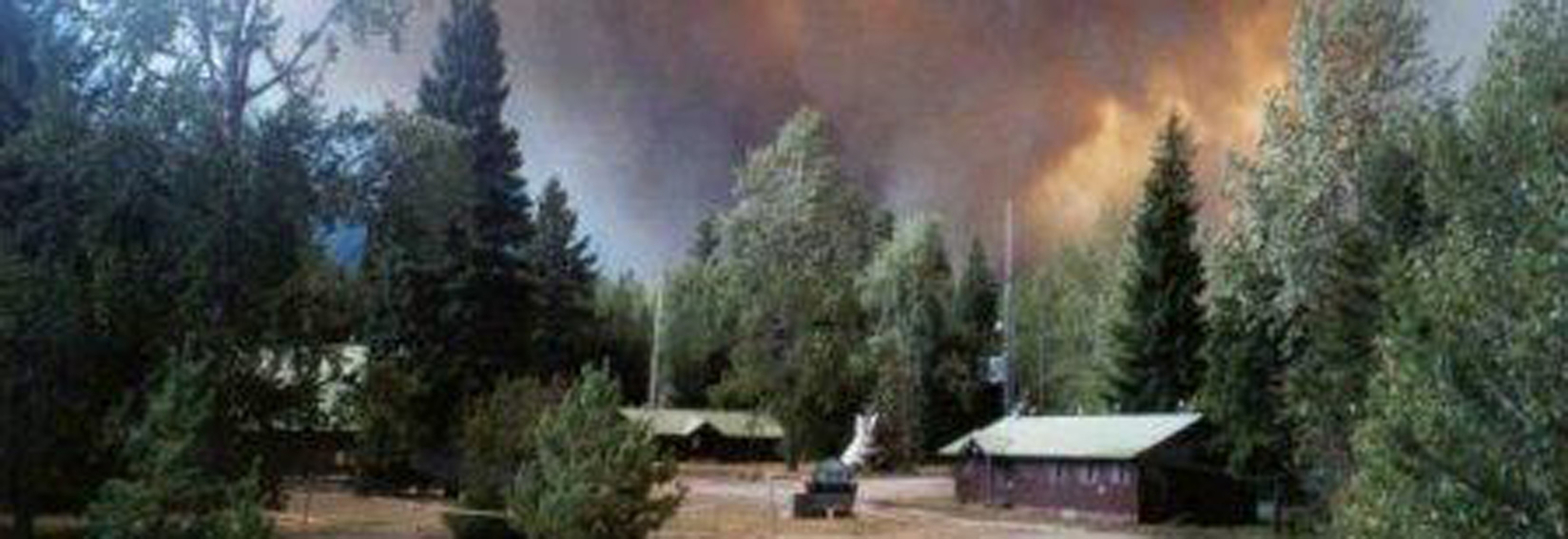
Fire at Big Creek

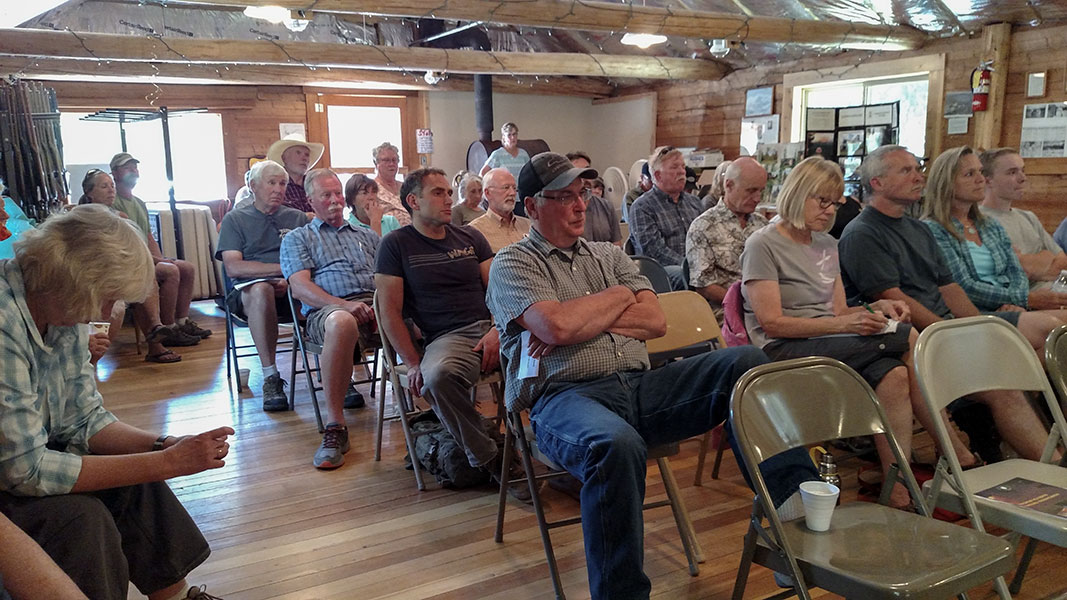
Come join neighbors and friends at Sondreson Hall on Thursday, July 12th at 9:30AM to learn how to protect your North Fork home. Watch fascinating videos and power point presentation by Stoltz Lumber’s Mark Boardman on thinning the forest around a home, and making open spaces for wildlife. Then travel to the Ulrichsen property, and see the results! 1 hr presentation, followed by a field trip of approximately 2 hrs. Mark Boardman also said we could get a tour of the Rittenburg property. This is the old Nature Conservancy property. Bring your own snack and drink. Kevin Ulrichsen, host

Fire Mitigation Committee 2018 Late Winter Update

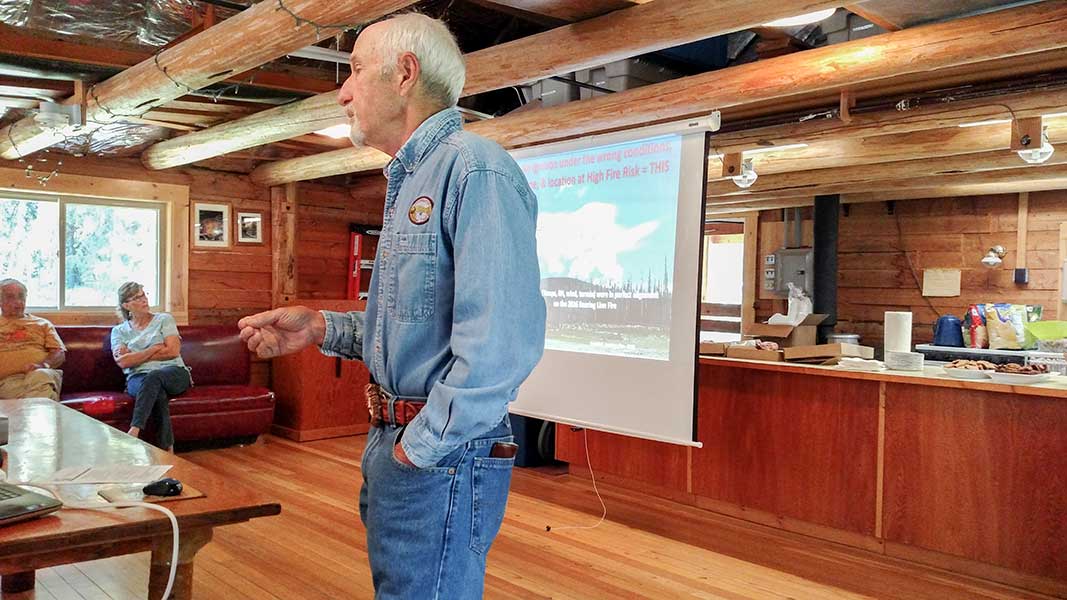
Mark Your Calendars! The Fire Mitigation Committee is planning for the North Fork’s 2018 Firewise Day, which will be held the morning of July 18 preceding the Summer Interlocal. The North Fork has been recognized as a Firewise Community since 2006. Come join our Celebration! Byron Bonney will be our featured speaker again. This year he will tell us about the effects of fuels treatments in the area burned by the 2017 Lolo Peak Fire south of Missoula, as well as some effects from the Sunrise Fire near Superior. Byron’s presentation last year focused on the Roaring Lion Fire, and the effects of fuel treatments on fire behavior. The treatments brought fire to the ground and limited the fuels that could be ignited by flying embers. They also improved the chance of survival for neighbors’ homes downwind. We are looking forward to Byron’s report on what he observed at the Lolo Peak and Sunrise Fires, and a look back at some of the fuel treatment “lessons learned” from the Roaring Lion Fire. You can download a copy of the agenda by tapping here.

While funds in our 4th Hazardous Fuels Grant are obligated, a new grant covering the North half of Flathead County has funds available that can be used in the North Fork. The Flathead Economic Policy Center (FEPC) administers the grants and provides landowners and the committee with invaluable technical assistance. Since taking over administration of Hazardous Fuels Grants in the North Fork in 2012 from the Northwest Montana RC&D, FEPC has administered over $153,000 in grants in the North Fork and treated 241 acres with landowner contributions totaling $129,000.

With the retirement of our friend Mason Richwine, a FEPC forester who has worked with many North Fork landowners, Tony Willits will be taking over administration of projects in the North Fork. We look forward to working with Tony, who brings a wealth of forestry and fire experience to the position as did Mason. Bill Swope will continue to work with us, and can be reached at 406-250-9812 or at bhswope@gmail.com.

Flathead County is continuing to work on revision of its Community Wildfire Protection Plan. The Fire Mitigation Committee expects to update its North Fork Wildfire Mitigation and Planning Report in conjunction with the county’s revision. We’ll need community input in the process. We’ll also need to update maps of the significant public and private work that’s been done on the North Fork since the fires of 2003.

June 2018 National Wildland Fire Outlook

There is essentially no change from the May Outlook for Northwest Montana.  I do see some indication that we might not have an extended season into October which would be good.  On the other hand, the monsoonal moisture that will be pushing up into the Yellowstone country could very well increase our dry lightning levels without bringing the moisture.  That could seriously affect us given hot and dry conditions.

We’ll look forward to the July issuance, but count on a very hot and dry July and August into September with a higher than normal wildfire activity level.  Get gutters cleaned out, lawns irrigated and mowed, and cleanup completed.

Here is the link to the June National Wildland Fire Outlook:  https://www.nifc.gov/nicc/predictive/outlooks/monthly_seasonal_outlook.pdf

Firewise Date is Wednesday, July 18th

Here is a note from Allen Chrisman, NFLA’s co-chair for the Fire Mitigation Committee… Here is the link to the June National Wildland Fire Outlook:

https://www.nifc.gov/nicc/predictive/outlooks/monthly_seasonal_outlook.pdf

There is essentially no change from the May Outlook for Northwest Montana.  I do see some indication that we might not have an extended season into October which would be good.  On the other hand, the monsoonal moisture that will be pushing up into the Yellowstone country could very well increase our dry lightning levels without bringing the moisture.  That could seriously affect us given hot and dry conditions.

We’ll look forward to the July issuance, but count on a very hot and dry July and August into September with a higher than normal wildfire activity level.  Get gutters cleaned out, lawns irrigated and mowed, and cleanup completed.

Fire Season Outlook May-June-July

Well, I had hoped that we would get a better forecast for the fire season.  This doesn’t look good.
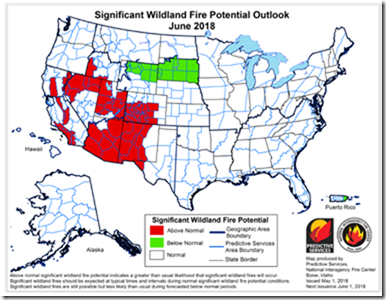
2018 Fire Outlook - June

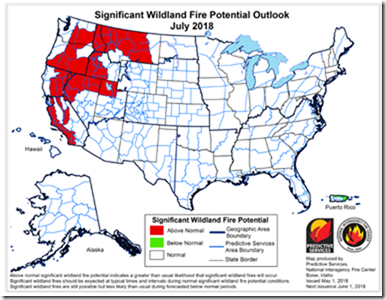
2018 Fire Outlook - July

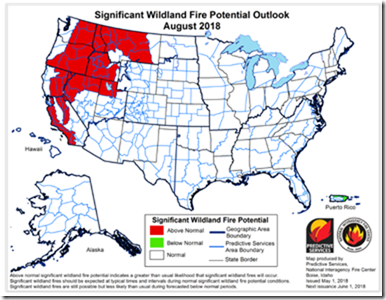
2018 Fire Outlook - August

Northern Rockies: Normal Significant Wildland Fire Potential is expected for the Northern Rockies in May and June. For July and August, Above Normal Significant Wildland Fire Potential is expected from central Montana west through the Idaho Panhandle, excluding the Beaverhead Deer Lodge National forest. In this and other, eastern locations Normal Significant Wildland Fire Potential is expected.

With near average temperatures and precipitation expected in May and June, Normal Significant Wildland Fire Potential is anticipated across the region as fuels will still be transitioning to drier levels, especially at higher elevations west of the Continental Divide. In early July, higher elevations may still be relatively moist due to the enhanced snowpack in the western areas. By the last half of July, however, heavy cured fine fuel loading and drier larger fuels are expected to elevate potential to “above-normal” in the Idaho and western/central Montana areas since the temperature and precipitation outlooks favor warmer and drier conditions. Above Normal potential with warmer and drier than average conditions will continue in August in those locations depicted on the maps. Southwestern Montana, Yellowstone National Park, and the Absaroka-Beartooth mountains/plateau, southwest Montana will remain near normal based on anticipated monsoonal moisture bringing adequate precipitation to these areas through the entire outlook period.

While the forecast for lightning is not included in this Outlook, the reference to monsoonal moisture moving into SW Montana implies that those air masses will be present in the Northern Rockies.  Even if the air masses dry out before hitting Northwest Montana, the residual moisture can lead to significant convection and lightning.  We can be hot and dry, but if we don’t get starts we can be OK.  If we get a lot of dry lightning under hot dry conditions, it will be very challenging.

We haven’t had back to back extreme fire seasons in the Northern Rockies in my experience.  However, we might be turning a corner on that this year.  Keep your fingers crossed and get your fuels work done and be squared away for initial attack.  Could be a bad one.

Download the full report from here. https://www.nifc.gov/nicc/predictive/outlooks/monthly_seasonal_outlook.pdf
Wildfire Risk Assessment Request

2017 was a record year for Wildland Fire in Montana with some 1.4 million acres burned. Fortunately, the North Fork escaped large fires. However, with our long history of large fires in 1988, 2001 and 2003, it is only a matter of time before we see large fire return to the North Fork. Many North Fork residents have taken advantage of the free Wildland Fire Risk Assessments provided by both the Flathead Economic Policy Center (FEPC) and Montana Department of Natural Resources and Conservation. If you are interested in a free Assessment, fill out the attached form and return it to the FEPC. Grant money is available to assist landowners with hazardous fuels projects if they are interested.

February 1, 2018 National Wildland Fire Potential Outlook

February 2018 National Significant Wildland Fire Potential Outlook

We are in good shape being out of season with reasonable moisture – snowpack is around 123% of normal for the Flathead.  I was just in Albuquerque last week, and they are in continued drought with their ski area unable to open because they have more bare ground than they do snow cover.  Grim.  Jackson Wyoming just cancelled a Skijoring event due to lack of snow as well.

I’ll keep you posted as things change going into the spring and continue into the fire season.  Fire season will be what it is, of course, but it is interesting to me to see how other parts of the country are being set up for active fire season.  That obviously affects availability of resources nationally when we do get active.
Be thankful we have as much snow as we  do.  It can’t hurt.

Here is the link to the February 1 National Wildland Fire Potential Outlook that covers February, March and April:

https://www.nifc.gov/nicc/predictive/outlooks/monthly_seasonal_outlook.pdf
Thanks!  Allen

Thank You for the Sunshine Committee

Here’s a message from Tom Marx… Thank you, Bonnie Ogle, of the Sunshine Committee for the Card and thoughts. I crashed a motorcycle on the first day of my “Once in a Lifetime” trip through the Alps. I managed to ride an hour and a half into a two week trip. It still was “A trip of a Lifetime”. I am in physical therapy now for a stretched and twisted left knee and ankle. Thanks again for the card and for thinking of me.

National Cohesive Wildland Fire Management Strategy September Newsletter

An Assessment of Wildfire Transmission and its Implications for Risk Governance

We thought that North Forkers would be interested in reading the Western Region National Cohesive Wildland Fire Management Strategy September Newsletter. It begins…

This has been a particularly tough season for stakeholders in the West. Cohesive Strategy’s Western Region and its partners are leading the charge to facilitate identification and implementation of collaborative, cross-boundary solutions to the complex, landscape-level issues we are facing today. The Cohesive Strategy is the right framework from which to continue to build social, political and scientific support to address these issues. Change will not occur overnight but together we can change the trajectory that can be plainly observed in recent fire seasons.

In this issue:

  • Collaborative Landscape Planning and Fuels Reduction Pays Off
  • “Why I Burned My Property and How I Shot It”
  • Public – Private Partnerships Paying Off During Montana Fires
  • An Assessment of Wildfire Transmission and its Implications for Risk Governance
  • Teaching Fire with Fire
  • Increases in Wildfire-Caused Erosion Can Impact Water Supply and Quality
  • What the Joint Fire Science Program Can Do for You
  • Upcoming Learning Opportunities

Tap here to read the full newsletter.

September Wildland Fire Outlook

Here is the link to the September/October/November Wildland Fire Outlook: https://www.nifc.gov/nicc/predictive/outlooks/monthly_seasonal_outlook.pdf

For September in the Northern Rockies: Above Normal significant large fire potential is expected in all areas except Yellowstone National Park and eastern North Dakota in September where Normal Potential is expected.

In October Above Normal significant large fire potential will continue across the southern Idaho Panhandle and across most of Montana, except the Kootenai Region and Southwest Montana. Western North Dakota will also experience elevated potential in October as well.

This is grim news. While we will see diminished potential for lightning starts as the season progresses, the relief we need in terms of a season-ending moisture event looks elusive. And with the number of new starts across the state during the past few days, there is a lot of fire on the landscape that will not go out on its own. In addition we don’t have enough overhead teams/crews/engines/aircraft to staff the fires that are active now.

This is going to be a very tough September and October for Montana. I’m hoping that escaped hunter fires don’t add significantly to the fire situation….

Let’s be careful out there.